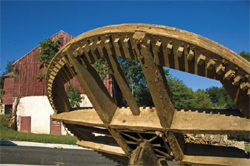
 Until very recently, the Thomas Phillips Mill was the sole survivor among the proliferation of mills, large and small, that once defined the prosperity of Delaware. It was also among the very few structures in White Clay Creek Hundred to be built of stone. The mill is remembered as both an 18th-century, family-run industrial complex and a hub of agricultural activities during the late 19th century. Farmers who traveled to the mill to have their grain ground into flour were said to have used the Miller's house as an overnight hotel. From an historic context, the importance of the Phillips Mill is well documented. In its heyday it reflected the evolving needs of local farmers as well as the demands of northern Delaware's urban market. Although its demise severs a link to the past, it will be remembered in the buildings that replaced it.
As recorded in the National Register of Historic Places, the Phillips Mill complex traced its history as a gristmill to 1795. Artifacts found on the property - the earliest a coin dating to 1714 - enhance the mystique. Architectural changes and alterations over the years served as a poignant record of the mill's economic rise and fall, which reflected the economic and social changes of the times as much as they documented the prosperity of the mil's owners. Phillips, an English immigrant who first resided in Maryland, bought the original 205-acre site at the "Head of the Christina" in 1794. Today, part of that plot includes the Fairfield Shopping Center and the Newark Country Club; the community of Christianstead occupies land that was once the millpond beyond the dam.
By 1798, Phillips had increased his land holdings to 254 acres and completed the original frame water-powered gristmill and sawmill. The nearby miller's house and owner's house probably were added to the complex sometime before 1821, during a period when Phillips also undertook an expensive renovation of the mill.
With a change of ownership, nineteenth-century modifications turned the miller's house into a Victorian dwelling, a sign of prosperity and a reflection of the architectural trend. References to what was then the McLaughlin Mill appear in both the Beer Atlas (1868) and the "Gawkers" American Flour Mill & Mill Furnishers Directory (1884). By 1885, it had been updated with modern, continuous automatic machinery and qualified as a full roller mill producing about 30 barrels of flour a day, the ultimate in production efficiency. By 1922, the mill had outlived its usefulness and all production ceased.
The 20th century saw a series of owners, who bit by bit sold off parcels of the vast land holding. By 1982, the last owner to occupy the dwellings was left with about six acres. The miller's house and owner's house were vacated in the 1990s.
In 2006, P.J. Bale, Jr. purchased the property with a vision to preserve its historic spirit and create one-of-a-kind residences that would live on for future generations.